Monday, 1 July 2019

Dinosaur knowledge

Room 7
Dinosaur knowledge
Prior Knowledge
In 2 weeks, we learnt that...
  • Animal
  • Predator
  • Dino is the root word
  • ‘Saurs’ means something
  • Species 
  • Extinct 
  • Huge
  • Large bones
  • Long necks
  • Eggs 
  • Sharp teeth
  • Long tails
  • Eat people
  • Different kinds
  • Spikes
  • Horns
  • Mammals
  • 4 legs
  • Bipedal means 2 feet and quadruped means 4 feet. Some dinosaurs are bipedal and some are quadrupeds. Some can change between the two stances. They are sturdy.
  • Theropod is a 3 clawed dinosaurs
  • Dinosaurs are warm-blooded, which means their blood temperature is always the same
  • Carnivore means a meat eater
  • Herbivore means a plant eater
  • Omnivore means it can eat plants and meat
  • Some dinosaurs are huge and some are small. Typically, huge dinosaurs were sluggish (slow). 
  • Dinosaurs died out 66 million years ago. They started existed 230 million years. 
  • They died because of an extinction event, most people think this was because a meteor hit the Earth. 
  • Dinosaurs legs go out the bottom of their hip bones, whereas reptiles bones go to the side of their hips. Reptiles do not have an extra hole in their skull, but dinosaurs do. 
  • Mary Anning found lots of fossils on a cliffside in England in the 19th century. She was born in 1799 and died in 1847. She survived a lightning strike as a baby. In 1824 she found the first fossil.
  • Non-avian dinosaurs are dinosaurs that are not birds. Avian means birds.
  • Metabolism means how fast or slow your body converts food into energy
  • Diverse means a big range
  • Modifications means changes. Dinosaurs have modifications such as spikes, armour, horns or crests. 
  • Clade means family.
  • Lineage means ancestors/descendants 
  • Paleontologists are scientists that study ancient things including dinosaurs
  • There are 4 main groups of dinosaurs; theropods, sauropods, ankylosaurus and pterosaurs.
  • Titanoboa was top of the food chain after the dinosaurs died. It killed people by constricting people. It spent most of its time in the water because it was super heavy. It was 13m long, as big as a bus. 
  • Hominins existed when 7-6 million years ago, the first humans to walk on 2 feet. 
  • People did not exist when dinosaurs existed.

  • Adaptation is something that changes over time. 
  • Ecology - how animals relate to each other
  • Fossils are made when dinosaurs die and their bones get trapped in rock or mud. The bones break down over time but leave a mould, which is filled with rock. This becomes the fossil. 
  • Dinosaurs sometimes eat each other. 
  • There were 3 periods of time that have dinosaurs. This is called the ‘age of dinosaurs’ also known as the ‘Mesozoic Era’; Triassic period, Jurassic period, and Cretasous period. 
  • Then there were 3 more periods in time, “Age of mammals”, also known as ‘Cenozoic Era’; Paleogene Period, Neogene period and  Quaternary period.
  • Dinosaur fossils have been found on every continent, including Antarctica.
  • Joan Wiffen found the first dinosaur fossil (a theropods tailbone) in NZ in 1975, in Hawkes Bay. She died in 2009. 
  • Dinosaurs laid eggs and they lived in family groups. 

  • Friday, 28 June 2019

    Thursday, 27 June 2019

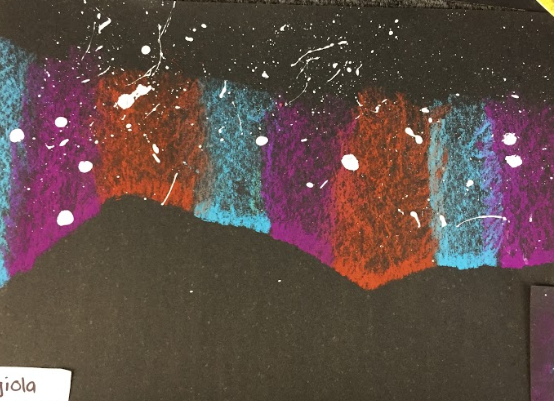
    Matariki Art

    On Monday 24th of June Room 7 was making Matariki stuff like
    Matariki art. 


    So first we did was to cut a mountain on a paper and get
    how many
    colours you want so you can make the Matariki thing.
    So my colours were blue, purple, and brown but it looks
    like red but it brown. And then Miss Ashley came and gave
    us a black cardboard so we can draw in and also she gave us paper
    clips so the mountain can stay still while we are drawing. Then Miss
    Ashley gave us an example on tripoli’s table then we were waiting so
    we can start .
    So then she was finished talking then I ran to my
    table and started to draw but then I almost made a
    mistake so then it when on the paper so I didn’t care so
    I just kept going so then I was nearly finished so then
    Miss Ashley got out the paint for the stars. Then I was
    finished then I started to do the star. Then I was finished .

    Wednesday, 26 June 2019

    The Matariki

    The Matariki
    Matariki is the name for a star cluster that includes the star Matariki.
    There is 9 stars called Matariki, Waiti, Waita, Tupu-a-nuku, Tupu-a-rangi,
    Waipuna-a-rangi, Uru-a-rangi, Hiwa-i-te--rangi, pohutukawa.
    The cluster is known by other names around the world one of
    these names is the pleiades Matariki is first seen in New Zealand skies
    between late May and early June.

    This marks the start of the maori new year the timing of celebrations differs
    amongst different iwi. Some start Matariki from the rising of the star Matariki.
    For other iwi, celebrations are started with the sighting of the star Puanga. The
    first full moon after Matariki marks the start of the new year in some areas. Still
    others start from the first new moon following Matariki appearance. The cluster
    disappears from New Zealand skies during autumn. This signals the time to harvest
    crops and fill the storehouses. As such, when Matariki could be seen
    once again, stocks would be full and celebrations and feasts could be
    held. 

    Traditionally, Matariki was a time for whānau to gather together. It was a time to remember and celebrate. It was also a time to share knowledge of the land and traditions. Matariki forms part of the Māori lunar calendar called Maramataka.
    The stars were used as a guide to the seasons. If the stars were bright, then
    a productive season lay ahead. When this happened, crops would be planted in
    September. When the stars were hazy or dim, planting.

    Friday, 21 June 2019

    All About Fossils


    Fossils are dead animals or plants. They are usually
    skeletons found embedded in rock. Sometimes fossils
    are footprints or poo. Small animals or insects get stuck
    in tree sap which hardens and traps them forever. Large
    animals can get trapped in ice, or their carcass gets
    trapped.
    in layers of rock. Over thousand of years, pressure
    builds up
    and the ground. Next  the mould left if filled with minerals
    that form rock. This rock is shape is the fossils - an exact
    replica of the dinosaurs. This process takes 10,000 years.
    Palaeontologists find fossils when the top layer of dirt or rock
    washes away.

    Friday, 7 June 2019